
Meta Description: Private credit has grown into a $2 trillion asset class in 2026, reshaping how companies access capital. Discover the key trends, opportunities, risks, and what investors need to know about direct lending, asset-backed finance, and retail access.
Target Keywords: private credit 2026, direct lending, private debt market, asset-backed finance, private credit investing, corporate lending alternatives, private credit risks, retail private credit, Basel III bank lending, private credit vs bonds
Introduction: The Quiet Giant of Modern Finance
Private credit does not make headlines the way crypto or stock markets do. It does not trend on social media or inspire YouTube investing channels. But quietly, methodically, and at extraordinary scale, it has become one of the most important forces reshaping global finance in 2026.
What began as a niche workaround for mid-sized businesses that could not access traditional bank loans has evolved into a $2 trillion asset class — one that now sits alongside bank loans and corporate bonds as a primary pillar of global corporate finance. Goldman Sachs has called private markets the “epicenter of dealmaking” in 2026. Moody’s projects the market will reach $3 trillion in assets under management by 2028. And 81% of surveyed investors plan to hold or increase their private credit commitments throughout 2026.
For borrowers, private credit offers speed, flexibility, and certainty of capital when public markets are closed. For investors, it offers yields that consistently outpace public debt alternatives, with structural protections that reduce downside risk. And for the broader financial system, it is filling a gap left by banks that have retreated from certain lending activities under the weight of post-crisis regulation.
This article explains what private credit is, why it has grown so explosively, what the key trends are in 2026, and — crucially — what risks investors and borrowers must understand before entering this market.
What Is Private Credit?
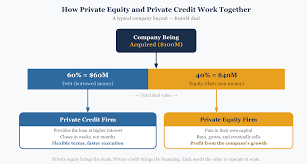
Private credit refers to debt financing that is arranged directly between a lender — typically an asset manager, private equity firm, or specialized fund — and a borrower, without the intermediation of a public market or traditional bank. The most common form is direct lending, where a private credit fund provides a loan to a company, typically with a floating interest rate and senior secured status.
Unlike public bonds, private credit transactions are:
- Negotiated directly between lender and borrower, allowing for customized terms
- Not traded on public exchanges, meaning pricing is less transparent but terms can be more flexible
- Often floating-rate, which historically has provided protection against inflation and rising interest rate environments
- Typically senior secured, giving lenders a claim on company assets in the event of default
Private credit has expanded well beyond direct lending in recent years to encompass asset-backed finance (ABF), mezzanine debt, distressed debt, infrastructure lending, and specialty finance — each serving different risk-return profiles and borrower needs.
How Private Credit Became a $2 Trillion Market
The roots of private credit’s ascent trace back to the Global Financial Crisis of 2008. The Basel III regulatory framework that followed required banks to hold significantly more capital against their loan portfolios, increasing the cost of lending and incentivizing banks to retreat from certain borrower segments — particularly middle-market companies that lacked the scale to access public bond markets.
Private credit stepped into this gap. Over the past fifteen years, the market has grown several-fold. The U.S. private credit market alone expanded from $500 billion to $1.3 trillion over just the last five years, and the global market now exceeds $1.96 trillion in 2026. This growth has been so significant that the Federal Reserve has noted private credit is now comparable in size to the markets for syndicated bank loans and corporate bonds.
Cleary Gottlieb’s 2026 outlook put it plainly: direct lending has grown to match the broadly syndicated loan market at $1.5–2 trillion in size. What began as an alternative for smaller deals has evolved into a primary financing channel for large public companies.
Several structural forces have driven this growth and show no signs of reversing:
1. Bank Capital Constraints: Despite some easing under revised Basel frameworks, banks continue to optimize return-on-equity and manage asset-liability mismatches. They are increasingly partnering with private credit managers — offloading risk through significant risk transfers (SRTs) and forward-flow agreements — rather than holding loans directly on their balance sheets.
2. Borrower Demand for Flexibility: For corporate borrowers, private credit offers speed, confidentiality, and certainty. When public debt markets seize up — as they did during the Federal Reserve’s aggressive 2022–2023 rate hike cycle — private credit keeps flowing. In Q2 2025, Ares Management alone held $150 billion in committed but undeployed “dry powder,” providing a massive cushion of liquidity available to businesses that need capital regardless of market conditions.
3. Investor Demand for Yield: In a world where traditional fixed income has offered compressed returns for years, private credit’s combination of floating-rate income, yield premium, and structural protections has made it highly attractive. The asset class consistently delivers a spread premium over comparable public debt, driven by illiquidity premiums, origination fees, and structural protections built into loan documentation.
Key Trends Shaping Private Credit in 2026
1. The Shift Toward Asset-Backed Finance
The private credit market is broadening beyond its corporate direct lending roots. Asset-backed finance (ABF) — which includes lending against pools of financial assets such as mortgages, auto loans, credit card receivables, equipment leases, and data center infrastructure — is emerging as the next major growth frontier.
The catalyst is clear: the five major technology hyperscalers have collectively announced over $1.5 trillion in capital expenditure over the next five years, driven largely by AI infrastructure buildout. This creates massive demand for long-dated, flexible financing solutions that private credit is uniquely positioned to provide. Asset-backed lending structures are particularly well-suited to financing data centers, transmission infrastructure, and other capital-intensive assets with predictable cash flows.
Moody’s forecasts that ABF will challenge — and potentially overtake — traditional direct lending as the dominant private credit strategy within the decade, as banks continue to de-risk balance sheets and private managers develop their own origination platforms.
2. Retail Democratization: Private Credit Comes to Main Street
Private credit has historically been the exclusive domain of institutional investors — pension funds, sovereign wealth funds, endowments, and insurance companies. That is changing rapidly, and the implications are significant.
A pivotal regulatory shift occurred in August 2025, when a U.S. Executive Order opened the door to alternative assets — including private credit — within 401(k) retirement plans. This development potentially unlocks trillions of dollars in retail capital that has historically been confined to traditional stocks and bonds.
The vehicles enabling retail access are multiplying: interval funds, evergreen structures, and Business Development Companies (BDCs) are making private credit accessible to individual investors with lower minimums, simplified onboarding, and periodic liquidity features — eliminating the traditional 10-year lock-up periods that excluded most retail participants.
For private credit managers, retail distribution offers a vast new pool of permanent capital. For retail investors, access to private credit promises genuine portfolio diversification and yield enhancement — though with important caveats around illiquidity, complexity, and valuation opacity that every investor must understand before committing capital.
3. Global Expansion: EMEA and Asia-Pacific Gain Momentum
Private credit’s growth is not confined to the United States. While the U.S. market remains the most mature, Europe and Asia-Pacific are accelerating rapidly.
Europe’s implementation of Basel IV is spurring banks to sell loan portfolios and engage in SME portfolio sales, creating dealflow for private credit managers. Private credit transactions in Europe currently offer a 50–150 basis point premium over comparable U.S. loans, while Asia-Pacific transactions offer an even larger 300–400 basis point premium — reflecting lower market penetration, added structural complexity, and higher jurisdictional risk that sophisticated investors are willing to accept in exchange for higher returns.
4. Banks as Partners, Not Competitors
One of the more counterintuitive dynamics of 2026 is the deepening partnership between traditional banks and private credit managers. Rather than competing head-to-head, the two are finding complementary roles.
Banks originate client relationships and provide certain services — revolving credit facilities, hedging, treasury management — while private credit funds provide the term loan or acquisition financing that banks prefer not to hold on their balance sheets. This “bank plus private credit” structure has become standard for many large leveraged finance transactions, and it benefits all parties: banks maintain client relationships without taking on capital-intensive balance sheet risk, while private credit funds access high-quality deal flow through bank origination networks.
5. CLOs and Liquid Credit Access
Collateralized Loan Obligations (CLOs) — structured vehicles that pool private loans and issue tranched securities against them — are becoming an important bridge between private and public markets. CLOs allow general partners to meet rising demand for liquid credit exposure while simultaneously granting access to retail and wealth management channels. Preqin forecasts a near 28% annualized surge in distressed debt fundraising by 2030, while mezzanine and special situations strategies are also attracting increasing interest from investors seeking differentiated risk profiles.
Investment Case: Why Private Credit Belongs in a Diversified Portfolio
The investment case for private credit in 2026 rests on several pillars:
Yield Premium: Private credit consistently delivers higher yields than comparable public credit instruments, driven by the illiquidity premium, origination fees, and PIK (payment-in-kind) components built into loan structures.
Floating-Rate Protection: Unlike fixed-rate bonds, most private credit loans carry floating rates tied to SOFR or equivalent benchmarks. This provides built-in protection against inflation and rising rates — though it also means income declines when rates fall, as they have been doing in 2026.
Structural Protections: Private credit agreements are negotiated directly with borrowers, allowing lenders to include covenants, collateral requirements, and other structural protections that are rarely available in public bond markets.
Portfolio Diversification: Private credit returns have historically exhibited low correlation with public equity and bond markets, making it a genuine diversifier in a multi-asset portfolio.
Demographic Tailwind: Aging global populations are driving demand for income-generating assets with predictable cash flows — a profile that private credit fits well.
A 2025 Preqin survey found that 18% of limited partners reported private credit exceeded their expectations, and 73% said the asset class met their expectations — an 91% satisfaction rate that is exceptional for any investment category.
Risks and Challenges: What Investors Must Understand
The growth and investor enthusiasm surrounding private credit should not obscure the genuine risks that the asset class carries — risks that are becoming more apparent as the market faces its first full credit cycle stress test.
Illiquidity Risk
Private credit is, by design, illiquid. Unlike public bonds that can be sold on an exchange, private credit investments are locked up for extended periods — typically three to seven years for traditional fund structures, and subject to limited redemption windows in newer retail vehicles. Investors who need liquidity in a stress scenario may find themselves unable to exit positions at acceptable prices.
Valuation Opacity
Private credit assets are not marked to market daily. Valuations are typically updated quarterly based on models, comparable transactions, and manager judgment — a process that can obscure deterioration in credit quality until it becomes impossible to ignore. This opacity is a feature for some investors (reduced volatility) but a risk for others (delayed recognition of losses).
Default and Credit Risk
While private credit portfolios have demonstrated resilience, the market has not been tested through a deep recession. Rising corporate defaults, tighter monetary conditions, and economic slowdowns create genuine credit risk — particularly in the lower-middle market, where borrowers may have less financial flexibility.
Regulatory and Legal Risk
The SEC’s 2026 examination priorities specifically flag private credit funds and investment advisers for scrutiny — focusing on risk disclosures to retail investors, valuation methodology, and conflicts of interest. Regulatory action has already begun and is expected to intensify as retail access vehicles proliferate. Civil litigation in this space is also increasing, as borrowers and investors challenge fund manager decisions in courts.
Systemic Risk Concerns
As private credit has grown to rival traditional bank lending in size, regulators including the Basel Committee have raised concerns about the interconnections between banks and private funds — particularly through significant risk transfer structures where banks pay private funds to absorb loan book risk. Excessive reliance on these structures could reduce banking system resilience if private credit capacity were to contract suddenly.
The Road Ahead: Toward $4 Trillion by 2030
The trajectory for private credit is clear: Moody’s projects assets under management approaching $4 trillion by 2030, while the total addressable market — across all asset classes that private credit could serve — exceeds $30 trillion globally.
Several forces will shape the next phase of growth. The expansion of retail access vehicles will bring new capital from wealth management channels. The AI infrastructure buildout will drive demand for asset-backed finance at scale. Global expansion into EMEA and Asia-Pacific will diversify origination. And the ongoing retreat of bank balance sheet lending will continue to create structural opportunity for private credit managers.
At the same time, the market will face its first genuine stress test as it navigates through a full credit cycle. Managers with rigorous underwriting discipline, deep origination networks, and robust portfolio monitoring will be differentiated from those who grew rapidly in a benign environment. For investors, manager selection — not just asset class exposure — will be the critical determinant of outcomes.
Conclusion: A Mainstream Asset Class, Not a Temporary Trend
Private credit is not a cyclical phenomenon or a temporary workaround for market dysfunction. It is a structural shift in how corporate finance works — driven by permanent changes in bank regulation, capital markets structure, and investor demand that will not reverse when interest rates move or markets stabilize.
For institutional investors, the case for private credit allocation has never been stronger — but position sizing, liquidity management, and manager due diligence have never been more important. For retail investors gaining access for the first time through 401(k) vehicles and evergreen funds, education is essential: private credit offers genuine diversification and yield benefits, but it demands patience, a long-term horizon, and a clear understanding of what you own and why.
The quiet giant of modern finance has arrived. The question now is not whether private credit deserves a place in a diversified portfolio — it is how much, through which vehicles, and with which managers.
Frequently Asked Questions (FAQs)
What is private credit? Private credit is debt financing arranged directly between a lender — typically an asset manager or private fund — and a corporate borrower, without using a public bond market or traditional bank. It includes direct lending, asset-backed finance, mezzanine debt, and distressed debt strategies.
How big is the private credit market in 2026? The global private credit market has exceeded $1.96 trillion in assets under management in 2026, up from $500 billion just five years ago. Moody’s projects the market will reach $3–4 trillion by 2028–2030.
Why is private credit growing so fast? The growth is driven by bank retreat from certain lending segments due to Basel III capital requirements, strong borrower demand for flexible financing, and investor demand for yield premiums above what public bond markets offer.
Can retail investors access private credit? Yes, increasingly so. An August 2025 U.S. Executive Order opened 401(k) plans to alternative assets including private credit. Interval funds, BDCs, and evergreen structures now offer retail access with lower minimums and periodic liquidity features — though investors must understand the illiquidity and complexity involved.
What are the main risks of private credit investing? The primary risks include illiquidity (funds are locked up for extended periods), valuation opacity (assets are not marked to market daily), credit and default risk, regulatory scrutiny, and systemic concerns about interconnections between private credit funds and traditional banks.
How does private credit compare to public bonds? Private credit typically offers higher yields than comparable public bonds, driven by an illiquidity premium and structural protections. However, it lacks the daily liquidity and price transparency of public markets, making it more suitable for investors with long time horizons and lower liquidity needs.
Disclaimer: This article is for informational and educational purposes only and does not constitute investment advice. Private credit involves significant risks including illiquidity and potential loss of capital. Always consult a qualified financial advisor before making investment decisions.